
Why use hollow core slabs?
Why use hollow core slabs? These pre-stressed floor slabs with either round or shaped voids are one of the most…
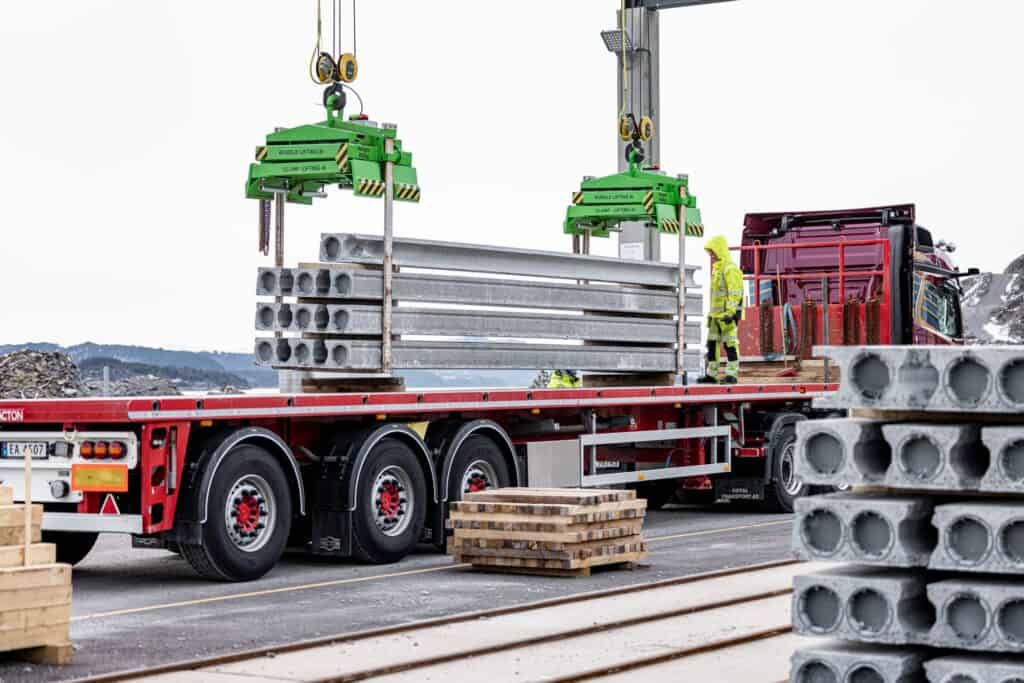
As you may know, hollow core slabs are a sustainable and versatile product for many purposes – they can be used as regular floors, walls, roofs and noise barriers – and increase the usable floor area due to long spans and high load-bearing capabilities. They are also quick to install – typical speed in residential construction is 8 slabs in an hour, which is equivalent to approximately 60 – 80 m2/hour. However, the benefits go further than that. There are two main perspectives on how hollow core slabs can be used efficiently: design and installation.
Everything begins with design – the benefits of hollow core slabs can only be grasped if the buildings are designed accordingly. Hollow core slabs can span up to 20 meters, which means that less load bearing walls are needed. This on the other hand results in a lighter overall structure, because smaller foundations are needed. What does this mean from the design point of view?

The optimal residential floor is constructed with a 200-370 mm hollow core slab. Further, they have only one rebar in slab seems, perimeter reinforcement and thin 20-30 mm screed. The thickness of the slab is affected by the stepping noise attenuation requirement. Seismicity and wind forces affect the amount of topping.
If the design of a building includes floor heating, it can be easily installed on top of hollow core slabs. A 20-35 mm thick insulation layer must be installed before laying the heating pipes on top after which the pipes are covered with fresh concrete.
It’s good to choose a cross section which can carry the required load with fewer strands. More strands can be added in places with higher loads. If there are openings or strands that need to be cut, it is better to have more strands.
It’s the same with the number of cores. If you want to split the slab in the middle, you want to have a 5-core slab instead of 4-core. Talking about splitting, you can also slit the slab when casting. But then you have two, e.g. 600+600 slabs for the whole length of the bed. But if you can use them, that is the easiest way. It is also easier to locate the openings in a slab with more cores. But don’t be fooled: adding core also increases weight. If you are not using the additional concrete to carry load, it is just extra weight.
Hollow core slab is an excellent moisture-proof, sound-proof and highly fire-rated product. However, making crosswise sewer pipe and ventilation duct lines is not an optimal way to go. Instead, you should try to design the building layout so that the ducts and pipes can be vertically installed in the building’s high areas.
The bathroom and kitchen should be situated close to sewer pipe and ventilation duct lines. That way you only need to make a false ceiling in the hall (entrance) of the apartment. Or even better, the ventilation and pipes can be connected directly to precast vent/pipe-element. Other rooms can have hollow core bottom as ceiling.
Electrical cables are led in the seams or at the end of slab, when going crosswise.
Let others enjoy this, too!
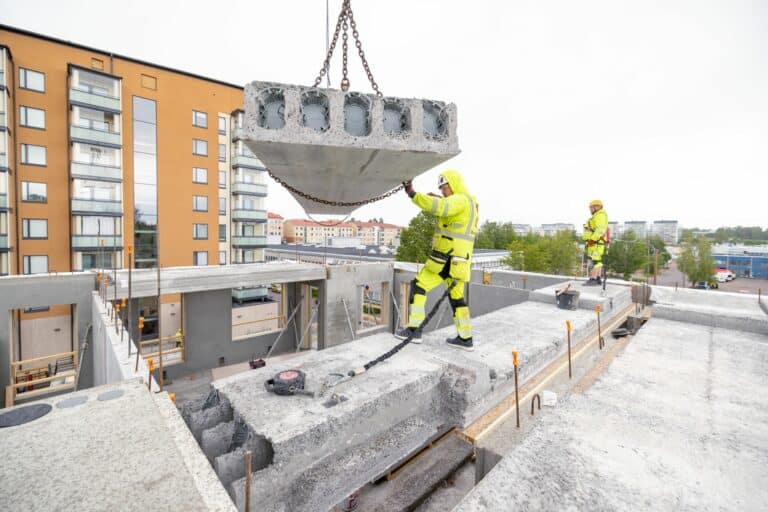
Quality, time, labor, cash and time-wise efficient designs don’t bring all the potential benefits to the construction sites unless the installation goes smoothly. Therefore, it’s wise to plan the installation sequence well in advance. Based on the plan, the slabs that are needed can be delivered to the construction site exactly when needed. Thorough plans do not only ease the installation process but also make the work safer.
The installation equipment should be chosen based on the slab lengths, weights, and profiles. Typically, hollow core slabs of 400-500 mm thick weigh 10-14 tons, which can be lifted with a mobile or tower crane. Lifting scissors are often used; however, sometimes lifting loops are also installed on the slabs during the casting phase. If heavy lifting machinery is not available, the slabs can be designed and produced as split slabs (600+600) weighing less than 5 tons each. All openings in the slabs impact what kind of lifting equipment can be used.
Whichever installation equipment you decide to go for, it’s of utmost importance to check that the equipment works as it should before the installation process starts. For example, remember to check that the lifting clamps match the lifting grooves of the hollow core slabs. Also, for longer and heavier (>8t) slabs, tandem clamps are needed.
Sometimes we get questions about the required weather conditions for installing hollow core slabs, but those don’t really exist. Of course, it is more pleasant to work on the construction site when the weather is nice; however, the slabs can be installed throughout the year: from hot and moist to cold and snowy. The only limitation is excessive wind, because the slabs need to be lifted to the building, and safety beats the speed of installation. However, when the weather is cold, hollow core slabs need to be warmed / melted down, often with steam, to be able to cast grout between the slabs. The slabs can also get slippery during winter.
Otherwise, the slabs are easy to install as all you need is a perimeter, corner iron, and attachable joints at the ends of each slab. For walls, you usually need loops on the sides; cantilever balconies require heavier joints and sometimes a 1.2 m wide half-slab is used to allow space for needed rebars and additional concrete. All slab joints must be cleared of all debris before grouting as well as after the installation process is complete. Note that the grout must be kept from freezing while curing. Despite the weather conditions, the drainage holes at the bottom of the slabs should always be checked after installation.
The main thing with the installations is to stick to the plan – which is planned according to the specifics of hollow core slabs – and follow safety measures set for construction sites.
To sum up, hollow core slabs provide many benefits to precast buildings; however, the benefits don’t get to shine unless the entire process from design to manufacturing and all the way to installations is planned smoothly and compatibly.
Why use hollow core slabs? These pre-stressed floor slabs with either round or shaped voids are one of the most…
What are the prerequisites for successful transition to automatic machines in hollow-core production? How to ensure…
or